BIOECONOMY WEEK: Science Espresso in Kraków

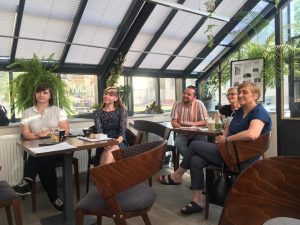
For 5 days: 24-28 June, we were meeting in a charming interior of Pojnarówka Art and Café to talk about chosen aspects of bioeconomy: the issues related to the food production and consumption.
During the event on the first day, we talked about food wasting. Wasted food has a huge impact for environmental, social and economic areas.
Considering that around 1/3 of food is wasted globally, the problem is not only the issue of efficiency in production, transport and food processing, but above all a significant external effect in the environment. One thrown away cheese sandwich equals 100 liters of wasted water, 1 kg of potatoes that have been forgotten rotten in the basement equals 300 liters of wasted water, one kilo of beef not used in a restaurant equals 6,000 liters of wasted water.
In Poland, per person, an average of 250 kg of wasted food per year. This is not a good result, where the European average is 179 kg. For comparison, in African countries, it is only 10 kg. In a country with almost 38 billion citizens, these figures translate into an astronomical volume of 9 billion tons of wasted food. This is the equivalent of 22.77 million tons of CO2, and that is just around the same amount, that all the cars are emitting during one year!
It is also 1.72 billion 3 wasted water – imagine that every day, every Pole pours into the sewage 100 1.5 bottles of water!
This situation requires the implementation of an innovative approach to the management of food production and consumption, but also changes in the mentality of consumers who are wasting food for prosaic reasons: missing the expiration date, improper storage, poor food quality purchase and for large purchases and large portions of food.