Becoming a bioeconomy pioneer – interview with Andrea Kerschner, AGRANA

| The main objectives of the BLOOM project are to raise awareness on the bioeconomy and to establish open and informed dialogues, co-created by European citizens, civil society, bioeconomy innovation networks, local research centres, business and industry stakeholders and various levels of government. BLOOM is creating spaces for the needed debate on preferences and values concerning the bioeconomy; for interaction and exchange of information, knowledge, meaning and aspirations, with the aim of establishing consensus on how a bioeconomy can be realized. Across Europe, five regional hubs have been established to foster public engagement in the bioeconomy and to create a space of exchange and debate. The hubs are focusing on different areas important to the regions. |
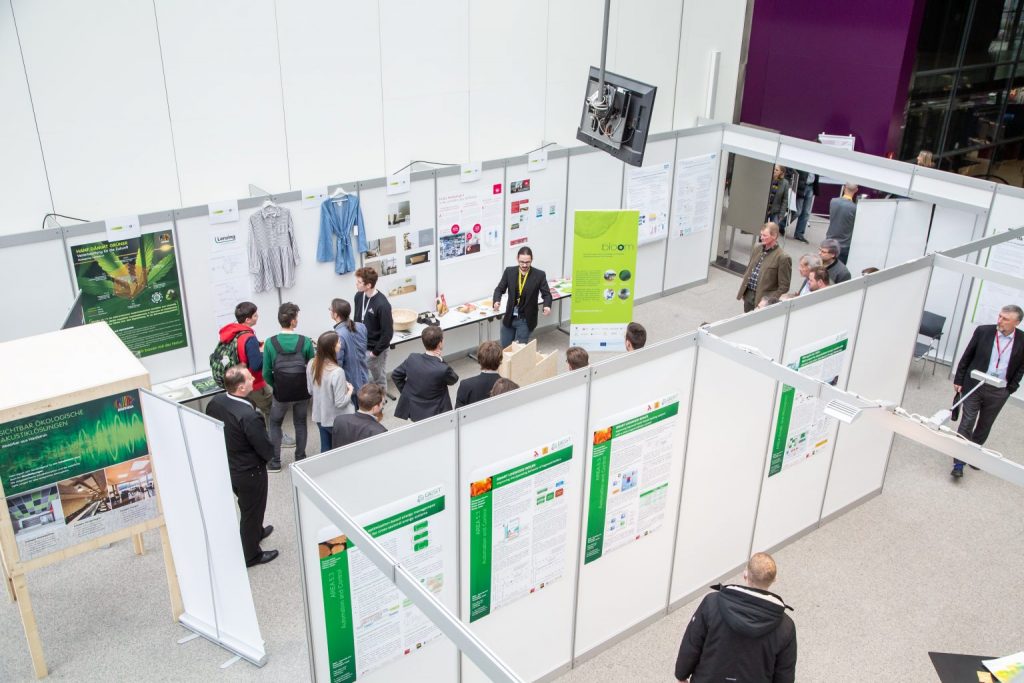
On the 23rd and 24th of January 2020, the gallery walk of the Austrian and German Hub offered a vivid opportunity to get in touch with real-life examples of bioeconomic action. In an interactive format, participants got in touch with real showcases – provided by pioneers of bioeconomy – followed by a discussion with leading experts and company representatives. The gallery walk took place at the 6th Central European Biomass Conference in Graz, Austria. The BLOOM communications team interviewed Andrea Kerschner from AGRANA, a fruit, starch and sugar processing company, to learn more about her experience and thoughts on the bioeconomy.
What kind of BLOOM activities have you been involved in?
The Ecosocial Forum has organized a gallery walk in the framework of the BLOOM project where different pioneering companies in the field of bioeconomy and innovative products have been showcased. Among the companies present was AGRANA, active in the field of fruit, starch and sugar production. I, Andrea Kerschner BSc, represented AGRANA at this event.
AGRANA is a pioneer in the field of bioeconomy and specializes in refining biomass from agriculture (corn, wheat, potatoe, sugar beet) into a variety of products for the industry. During the gallery walk, our AGRANA biorefinery in Pischelsdorf was presented as an example of successful implementation of the bioeconomy. In the modern factory, we achieve the complete (approx. 99.3%) use of the raw materials in all segments, by producing different side products for various industries. This happens through the efficient use of raw materials, technical innovation and the continuous development and optimization of the products. Our biorefinery in Pischelsdorf produces bioethanol, feed, proteins, liquid CO2 and high purity starch for the food industry and for technical applications (paper production and as glue for corrugated cardboard). The remaining 0.7% of raw material goes to the local sewage treatment plant and is further processed into biogas and sewage sludge (compost). Our implementation of the “ZERO WASTE” principle with an almost 100% raw material utilization sets an example both in the technological and societal discussion on bioeconomy.
During the gallery walk, I further explained the topic of bioethanol, which is currently mixed at a ratio of 5% into fossil fuel in order to improve the carbon footprint. A higher ratio of bio-ethanol in fuel would not only further improve the carbon footprint, but also significantly reduce the particle emission of cars. A study from the Technical University of Vienna shows a significant reduction in fine dust particles: compared to the current fuel mixed with 5% bio-ethanol, the particle emission could be reduced by up to 23% by adding 10% bio-ethanol.
Additionally, during the gallery walk our new product AGENACOMP©, AGRANA’s bioplastic compound made from thermoplastic starch (raw material: corn), was presented. From this compound we produce bioplastic bags that don’t leave any microplastics residues and are home compostable, which means that they decompose well even at low temperatures. By composting it, the cycle from plant to starch to bioplastic, to compost and to the growth of new plants is completely closed.
Can you share a personal story on what kind of changes have been initiated through your involvement in BLOOM?
Thanks to BLOOM there was an active exchange between the visitors of the Central European Biomass Conference and AGRANA. We did not only reach a professional audience, but also the general public that visited a building exhibition on the same site. Among the professionals were technicians, chemists and pioneers in the field of bioeconomy. Also, many students that cover the topic of bioeconomy in their specialization have visited our booth. My main task was to build a connection between the visitors and the technicians of the biorefinery Pischelsdorf. Many visitors already knew about the biorefinery and were very interested in learning more about the processes.
I was surprised by the reactions to our bioplastic bags. Many visitors were interested in them, but also very critical towards bioplastics and putting many aspects into question – because as everyone knows, a bioplastic bag is not necessarily equal to another bioplastic bag. Bioplastics can be produced from renewable sources (e.g. starch, sugar, cellulose) or partly from fuel. They can be compostable, or they can have the same properties as conventional plastics and not decompose during a long time period. AGRANA’s bioplastic AGENACOMP© is mainly made from starch, which is also commonly used for many other applications in the paper industry and for glue production. AGENACOMP© is home compostable (meaning that you can compost it at a temperature between 20-30°C and it decomposes in 6 months) and is completely free from microplastics. For me the critical attitude of the visitors was very positive, because it showed me that they have been thinking about waste reduction and sustainability and are able to question those topics. It also showed me that people tend to act more consciously and try to live a healthier life. They feel responsible towards themselves, their fellow human beings and nature.
Have you been involved in the bioeconomy before? How has the engagement in the bioeconomy changed through BLOOM?
I finished my studies at the University of Natural Resources and Life Sciences in Vienna and sustainability and ecology have always been important topics for me. I am very happy to have the possibility to work for a company that cares about bioeconomy. Due to the business activity of AGRANA and its direct relation to agricultural production, sustainable business is an integral aspect of our model. For AGRANA, sustainability means to act in a profitable, resource-saving and energy efficient way and to respect both internal and external stakeholders.
BLOOM made it possible for us to present the engagement of AGRANA in the areas of carbon and plastic waste reduction to an interested general public.
How should the implementation of the bioeconomy evolve, according to your opinion?
AGRANA is holding a pioneering role in the industry, and for me personally through my involvement in BLOOM it has become clear that bioeconomy is not an end state – an ongoing development and optimization are necessary.
We live in a world with limited resources – it is for us to treat them in a responsible way! In my opinion, bioeconomy needs to move stronger into focus through awareness raising, research and the creation of financial incentives. In times like these (Covid-19, climate crisis etc.) it becomes visible that a shift of mindset and a shift in our economic systems are inevitable. To live and produce in a sustainable way, to see the bigger picture and to think in cycles needs to become more and more important – bioeconomy can be one of the important leverages of our time!
Written Interview by Andrea Kerschner, AGRANA
Translated by Sarah Friederich, GEN Europe