Making the bioeconomy graspable – A conversation with Veronika Hebenstreit, president of the board of the Ecosocial Students Forum

| The main objectives of the BLOOM project are to raise awareness on the bioeconomy and to establish open and informed dialogues, co-created by European citizens, civil society, bioeconomy innovation networks, local research centres, business and industry stakeholders and various levels of government. BLOOM is creating spaces for the needed debate on preferences and values concerning the bioeconomy; for interaction and exchange of information, knowledge, meaning and aspirations, with the aim of establishing consensus on how a bioeconomy can be realized. Across Europe, five regional hubs have been established to foster public engagement in the bioeconomy and to create a space of exchange and debate. The hubs are focusing on different areas important to the regions. |
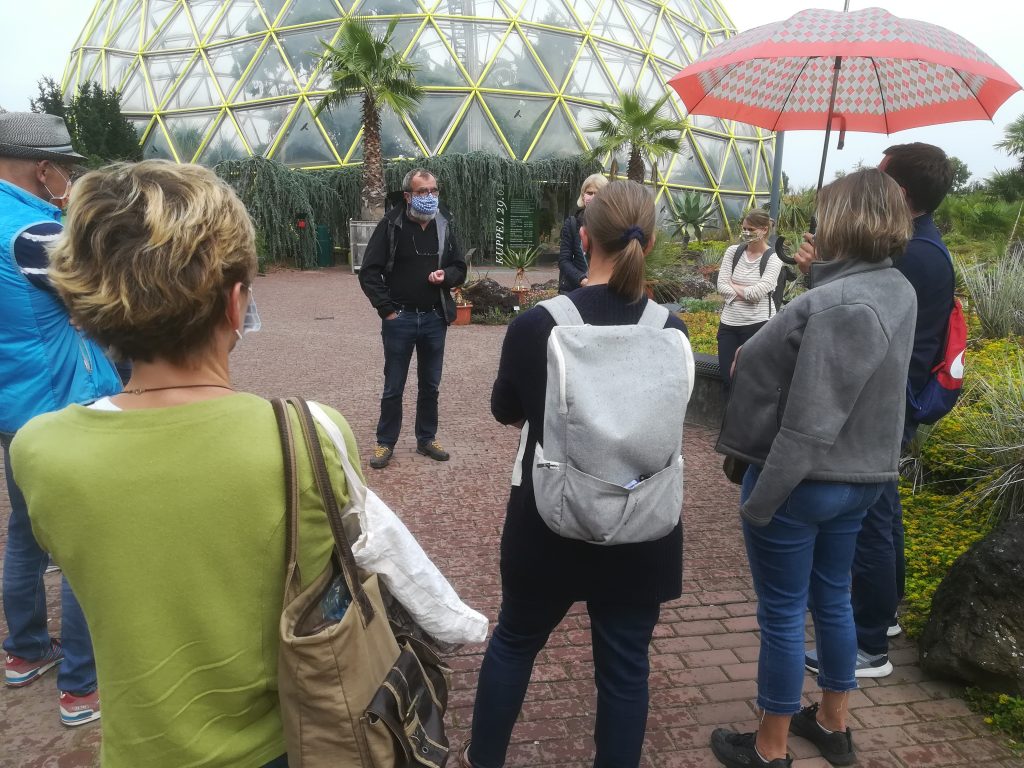
On 25th September 2019, students and young farmers from Austria took off to the Netherlands, where they were able to dive deeper into the fields of bioeconomy and circular economy and to engage in workshops, seminars and hands-on experiences. The young people visited scientific institutions, companies and organizations, but the tour started in earnest on the train already, where a workshop and a lively discussion was held about how to integrate bioeconomy in everyday life. The BLOOM communications team interviewed Veronika Hebenstreit, who is the president of the board of the Ecosocial Students Forum, to learn more about her experience and thoughts on the bioeconomy.
How has your understanding of bioeconomy evolved through your involvement in an activity organized by BLOOM?
Before the study trip, I had heard the word bioeconomy, but I didn’t know exactly what it was. During the workshop on the train to the Netherlands, we realized that we all had a certain understanding of the word and know different aspects of it, and that bioeconomy actually encompasses all of what we knew, which is basically anything you can make from biomass.
It was very helpful to see real examples of the implementation of the  bioeconomy, combined with hands-on experiences. At the University of Wageningen we learned more about bioplastics. I was already aware that bioplastics exist, but I didn’t know anything about the background and their advantages and disadvantages. During the study trip, it was very interesting to see very diverse examples of how the bioeconomy can be implemented. We also visited the World Horti Center, a glasshouse center and a very technological example of bioeconomy implementation. It was interesting to learn more about the efficiency of glasshouses, and at the same time for us it was very distant from nature, and so we had mixed feelings about it. Our visit to Rotterzwam, a company that cultivates edible mushrooms on coffee grounds, was quite different. The solutions implemented there are more natural and simple, and follow the principles of the circular economy. The company rethinks waste and recycling management and tries to find ways to make every tiny step in the production process more circular. Our visit there was very experiential, since we could make our own bags with coffee grounds and mushroom substrates and take them home with us. So now we are all growing our own oyster mushrooms, and we are still connected as a group, exchanging about the progress of our mushroom cultivation.
How do you feel the implementation of the bioeconomy should evolve?
One of my main insights from the study trip is that bioeconomy can be a great solution for more sustainability, but it doesn’t have to be. It depends on how it is implemented. During the study trip, we discussed the question in which direction it should evolve a lot, especially because of the size and scope of everything contained in the word “bioeconomy”. For me, the circular aspect plays a very central role. It only makes sense to make products based on natural resources if the design of their whole life-cycle is circular. For instance, whether the product is compostable or not. Bioplastic doesn’t make sense for me if I still have the plastic at the end and don’t know what to do with it when I don’t need it anymore. For a bioeconomy to really be sustainable, it has to be based on the principles of the circular economy.
Has the BLOOM study trip motivated you to engage more in the bioeconomy?
The study trip has awakened more interest in the topic of bioeconomy. After the trip, two other students and I participated in another event on bioeconomy at our university. Thanks to the background information we now have, we could actively participate in the discussions during the event. I think some of us could imagine potentially working in the field of bioeconomy in the future, since we are studying Environmental and Bioresource Management or Agriculture – two fields that are closely linked to bioeconomy. I think we would be more open to this possibility, because now we know what bioeconomy actually is and what possibilities there are. We really enjoyed the study trip, and have started to think about planning a study trip each year!
Interview made by Sarah Friederich, GEN Europe