
Can wood replace plastics?

Plastic is a great material which outperforms many other materials because it’s light, easily shaped, strong and inexpensive. It can also be used in sterile medical environments such as hospitals and it helps to minimize food waste. But plastic has also drawbacks especially when it comes to biodegradability or extraction of fossil-based oil. And this is where new bio-based solutions come in!
In the Central Library of Jyväskylä, Finland, the possibilities of wood in replacing plastics were discussed in Nov 21st. Senior Scientist Elina Pääkkönen from VTT Technical Research Centre of Finland presented research she’s involved in and also other applications in which wood has been used to replace plastics. Elina is a true professional in the field and she has been awarded about her work within new fiber-based solutions.
The seats in front of the stage started to fill in slowly and some by-passers stopped for a while to listen Elina’s presentation. After the discussion had started, it would have continued until the closing time of the library!
Wood-based foam to save the world
Finland is one of the leading countries developing new wood-based solutions to replace fossil-based materials. “In Finland, we have the tendency to look into the forests”, said Elina Pääkkönen referring to the focus on wood-based fibres. All of the plants contain cellulose and many of them could also be used to produce substitutes for fossil-based materials such as plastics.
VTT has been developing foam forming technology, which actually isn’t a new invention but recently the research around it has increased due to the demand for more sustainable materials. In foam forming, wood pulp is mixed with water to make foam. Air is added into the process making the result less dense.
The foam formed cellulose-based material offers a great alternative for package cushioning materials, such as EPS (expanded polystyrene), and plastic bags, which pose a big problem globally as microplastics from them enter the environment. The foam formed cellulose-based material is 100 % renewable and it can be recycled in the same way as cardboard. The packaging or cushioning materials can also be composted after usage.
“Finland is truly a number one globally when it comes to foam forming technology”, said Elina Pääkkönen. Indeed, she has been travelling around the world to present their work and she also won a prize in Blue Sky Young Researchers and Innovation Awards in 2017 with her research topic “How to replace non-renewable packaging materials?”.
Bio-based vs. biodegradable
Elina Pääkkönen highlighted the difference between bio-based and biodegradable. She showed that not all bio-based products are biodegradable and that not all biodegradable products are bio-based. Quite confusing, isn’t it? Maybe a picture can clear it out:
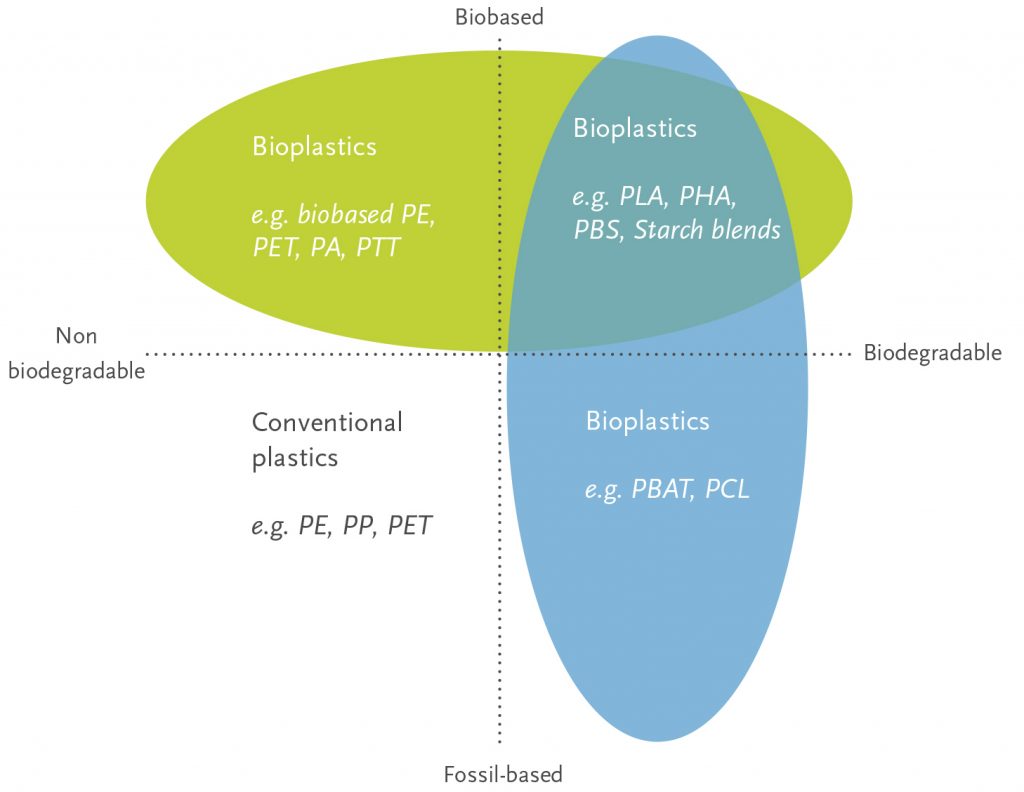
Source: European Bioplastics
People often get confused with the terminology and tend to mix the concepts. But for a consumer, it’s really important to recognize that not everything that’s made out of bio-based materials is automatically biodegradable. And, on the other hand, that some biodegradable materials can be made out of fossil-based raw materials too.
Can and should we replace plastics with wood?
Yes we can but no, we shouldn’t replace everything, argued Elina Pääkkönen. It’s really important to think where the benefits of a specific material exceeds the benefits of the competing materials. Conventional plastics still outperform bio-based plastics in some applications and their use in these applications may be well reasoned. In some other applications, bio-based plastics have greater benefits than conventional plastics and there bio-based options should definitely be favored and further developed. From a consumer point of view, the most important things are:
- Consider, whether the package or product is necessary to buy.
- Find out how to recycle the packages correctly and act accordingly.
No plastics, whether it’s bio-based or conventional, should enter the environment!
The discussion session is part of the BLOOM Nordic hub’s “Let’s talk about wood!” discussion series. The next session will be held in Dec 2nd at 18 o’clock in Jyväskylä Central Library with the topic “Circular bioeconomy – the future of Finnish forest industry?”. Find out more.
Written by Aino Voutilainen from JAMK University of Applied Sciences


